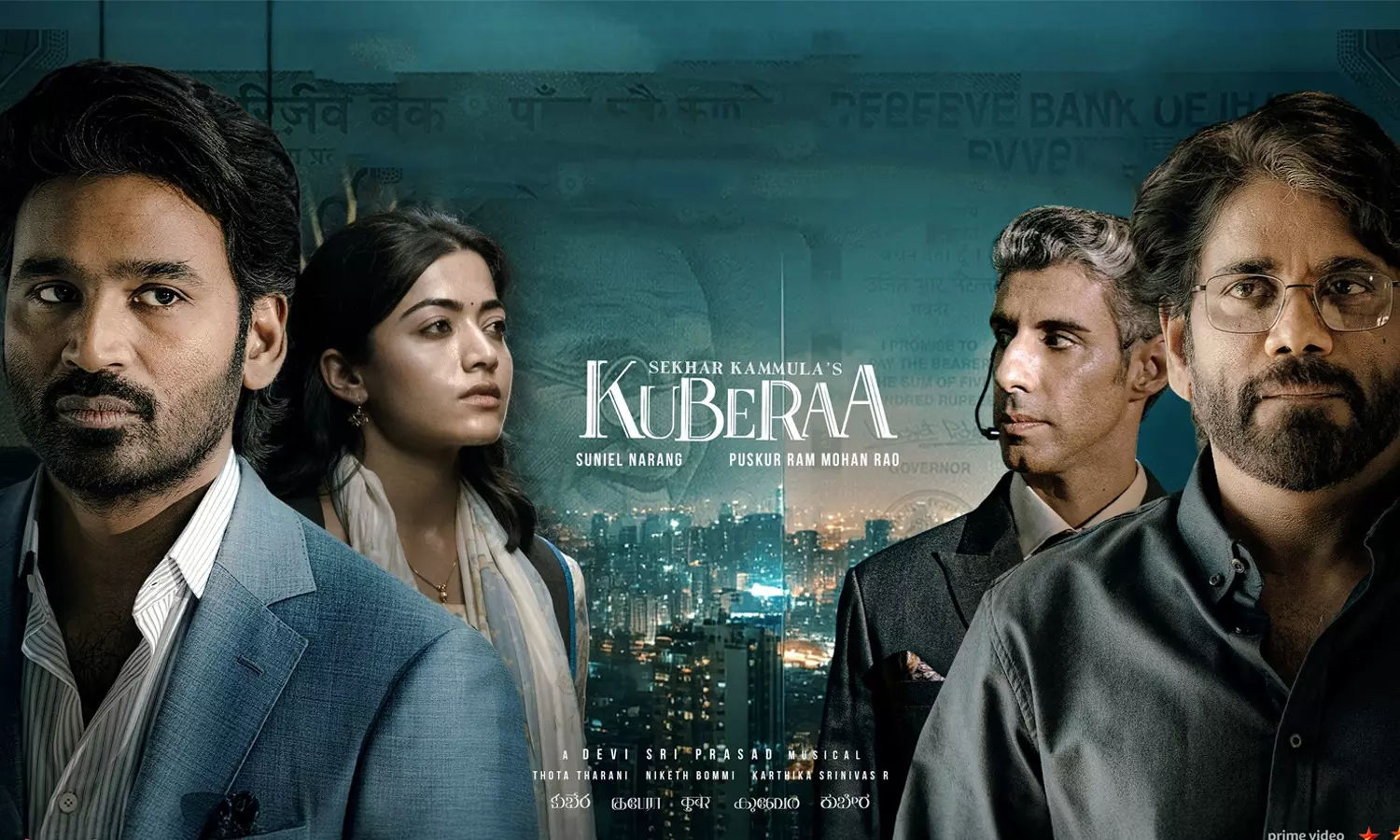

There’s a particular moment in Kuberaa when the film stops pretending to be a conventional crime drama and reveals what it actually wants to be: a confrontation. Not with gangsters or law enforcement, but with the audience’s comfort around wealth, power, and the stories we tell ourselves to justify both. From that point on, the film becomes less interested in entertaining you and more interested in cornering you.
Whether you enjoy that is another question entirely.
Quick facts
Kuberaa is an Indian crime drama directed by Sekhar Kammula, a filmmaker better known for humanist storytelling than genre aggression. The film stars Dhanush in a central role that leans heavily on moral ambiguity, alongside Nagarjuna Akkineni and Rashmika Mandanna in key supporting parts. Running close to three hours, Kuberaa blends social commentary with crime-thriller elements, positioning itself as a serious-minded examination of capitalism, corruption, and conscience rather than a crowd-pleasing spectacle.
Plot overview (no spoilers)
The film follows a man who rises from relative obscurity into proximity with immense wealth and influence. This ascent isn’t framed as destiny or luck, but as a series of calculated compromises — some small, some unforgivable. As financial power becomes easier to access, moral clarity becomes harder to maintain.
Rather than focusing on a single criminal empire or rival faction, Kuberaa expands outward. Politicians, corporations, fixers, and everyday people orbit the same system, each playing their part in sustaining it. The central conflict isn’t about taking down a villain; it’s about whether opting out of the system is even possible once you’ve benefited from it.
The story progresses less like a straight line and more like a tightening net.
Analysis & critique
Story & pacing
Sekhar Kammula tells this story with patience — sometimes to a fault. The narrative is deliberately layered, introducing characters and motivations gradually, often revisiting the same events from different emotional angles rather than advancing the plot in obvious ways.
The pacing will test viewers expecting a slick thriller. The first half unfolds methodically, almost cautiously, as if the film is daring you to lean in rather than chasing your attention. Some scenes linger longer than necessary, especially conversations that circle around ideas the audience already understands.
But once the story gains momentum, it becomes clear why that groundwork matters. The second half isn’t about twists or revelations — it’s about consequences stacking on top of each other. Every earlier compromise comes back heavier, uglier, and harder to justify.
The script’s greatest strength is also its risk: it refuses to simplify complex systems into digestible villains. That makes the film intellectually engaging, but occasionally emotionally distant.
Performances
Dhanush carries Kuberaa with a performance built on restraint. This isn’t a flamboyant rise-and-fall arc. He plays his character as someone constantly negotiating with himself — calculating, observing, adjusting. The charisma is understated, almost reluctant, which makes the moral erosion more believable.
What Dhanush does particularly well is resist audience alignment. He never asks for sympathy, and rarely offers justification. You’re left to decide whether understanding his choices means excusing them.
Nagarjuna Akkineni brings a quiet authority to his role, embodying a version of power that doesn’t need to announce itself. His performance is composed, strategic, and faintly menacing — not because of overt cruelty, but because of how normalized his influence feels.
Rashmika Mandanna’s role is more functional than transformative. She provides emotional grounding and perspective, but the script limits how deeply her character can challenge the system she’s embedded in. It’s a solid performance constrained by narrative priorities.
The supporting cast largely serves the film’s thematic goals rather than individual arcs, which works conceptually but occasionally flattens emotional impact.
Visual style & cinematography
Visually, Kuberaa is grounded and unspectacular by design. The cinematography avoids glamorizing wealth or criminality. Offices feel sterile, luxury feels cold, and public spaces feel transactional rather than alive.
The camera favors medium shots and observational framing, placing the audience in the position of a witness rather than a participant. There’s very little visual excess — no flashy montages, no fetishization of money or power.
While this restraint reinforces the film’s message, it can also make sections feel visually monotonous. The film prioritizes meaning over momentum, and that choice is felt throughout.
Music & sound
The score is subdued, often bordering on invisible. Music is used sparingly, usually to underscore tension rather than emotion. This restraint prevents manipulation but also limits catharsis.
Sound design emphasizes realism — ambient noise, overlapping dialogue, the hum of machinery and crowds. Silence is frequently used after major decisions, forcing the audience to sit with the weight of what’s just happened.
It’s effective, but not memorable. The film doesn’t want its music to linger longer than its ideas.
Themes & meaning
Kuberaa is fundamentally about moral outsourcing — the idea that responsibility can be deferred, diluted, or passed upward until no one feels accountable.
The film challenges the myth of the “clean” billionaire or the ethical participant in an unethical system. It suggests that corruption isn’t always violent or dramatic; often it’s bureaucratic, normalized, and deeply boring.
Importantly, the film doesn’t pretend to offer solutions. There’s no revolutionary fantasy here, no heroic takedown. What it offers instead is discomfort — the recognition that many people benefit from systems they publicly condemn.
Whether that’s enough will depend on the viewer.
Strengths and weaknesses
Kuberaa is intellectually rigorous and thematically confident. It treats its audience like adults, trusting them to follow complexity without hand-holding. Performances are controlled, the writing is thoughtful, and the film’s moral stance is clear without being preachy.
Its weaknesses lie in engagement. The pacing is demanding, the visuals are restrained to the point of blandness, and emotional connection takes a backseat to ideological exploration. Some characters feel more like arguments than people.
Compared to more commercial Indian crime dramas, Kuberaa is less exciting but more honest. Compared to Sekhar Kammula’s earlier work, it’s colder and more confrontational.
Who is this movie for?
Kuberaa is for viewers who appreciate slow-burn narratives and social critique, and who don’t need constant stimulation to stay engaged. If you’re interested in films that interrogate power rather than celebrate it, this will likely resonate.
If you’re looking for sharp twists, mass appeal action, or emotional payoff, this film may feel deliberately withholding.
Final verdict
Kuberaa doesn’t entertain you into agreement. It wears you down into recognition.
It’s a demanding, sometimes frustrating film that refuses easy answers or moral comfort. Not every scene lands, and not every choice is engaging — but the film’s conviction is hard to dismiss.
Power, Kuberaa argues, isn’t corrupting because it’s evil. It’s corrupting because it’s convenient. And once you’ve accepted that convenience, walking away becomes the hardest choice of all.