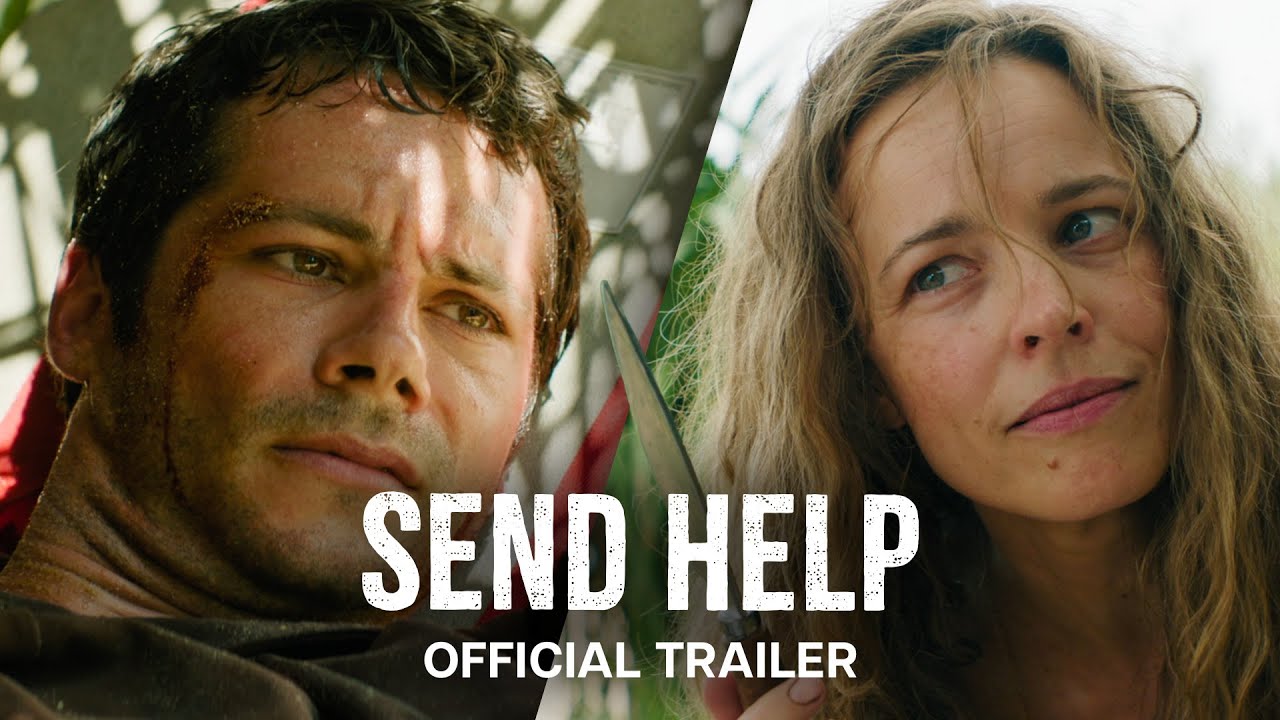

About half an hour into Send Help, the movie stops pretending it’s about survival logistics and starts revealing what it’s really interested in: what happens when two people are forced to confront each other with no distractions, no exits, and no one else to perform for. The plane crash, the wreckage, the isolation — those are just the door slamming shut. What follows is a pressure cooker disguised as a survival thriller.
This isn’t a movie that wants to impress you with clever tricks or constant escalation. It wants to sit you down and ask an uncomfortable question: How long can civility survive when there’s nothing left to hide behind?
Whether that’s compelling or exhausting depends entirely on what you’re looking for.
Quick facts
Send Help is a survival thriller directed by Sam Raimi, a filmmaker known for balancing tension, dark humor, and character-driven chaos. The film stars Dylan O’Brien and Rachel McAdams as the sole central figures, carrying nearly the entire runtime themselves. Stripped of spectacle and secondary characters, the movie runs just under two hours and leans heavily into performance, dialogue, and psychological attrition rather than traditional action beats.
This is Raimi operating in restraint mode — less spectacle, more slow burn.
Plot overview (no spoilers)
After a catastrophic plane crash leaves them stranded on a remote, inhospitable island, two strangers are forced into reluctant partnership. Resources are limited. Rescue is uncertain. Survival becomes a daily negotiation rather than a clear plan.
As days stretch into weeks, the external threat of the environment slowly gives way to internal conflict. Old wounds surface. Secrets emerge. The question of how to survive becomes secondary to why one should keep going — and at what cost.
The film resists the urge to introduce artificial villains or surprise twists. The danger is constant, but it’s quiet. Hunger, exhaustion, and emotional baggage do most of the damage.
Analysis & critique
Story & pacing
Send Help tells a deceptively simple story. Two people. One location. A situation that refuses to resolve quickly. Raimi commits fully to minimalism, and that commitment shapes the film’s pacing — slow, deliberate, and occasionally uncomfortable.
The first act moves with familiar survival-thriller beats, but once the initial shock fades, the film shifts gears. Scenes linger longer than expected. Conversations repeat, not because the script is lazy, but because stagnation is the point. This is a story about being stuck — physically and emotionally.
That said, the pacing will test patience. The middle stretch, in particular, risks monotony. The film trusts that escalating psychological tension will compensate for the lack of plot movement, and while it mostly succeeds, there are moments where restraint drifts dangerously close to inertia.
The script’s greatest strength is its refusal to manufacture drama. Conflict arises organically from personality clashes and moral compromise rather than contrived obstacles. When the film does reach moments of heightened tension, they feel earned — and unsettling precisely because they aren’t flashy.
Performances
The film lives or dies on its performances, and for the most part, they deliver.
Dylan O’Brien sheds any lingering charm early on, playing his character as guarded, reactive, and increasingly brittle. His physical deterioration mirrors his emotional unraveling, and O’Brien handles that descent with convincing restraint. He doesn’t beg for sympathy — and that choice makes his vulnerability hit harder.
Rachel McAdams brings controlled intensity. Her performance is quieter, sharper, and more emotionally layered. She understands that power in this story doesn’t come from dominance, but from endurance. Small choices — a pause before speaking, a withheld reaction — do heavy lifting.
Their chemistry is intentionally abrasive. These characters don’t soften each other; they grind each other down. That friction is the film’s core engine, and both actors commit fully to it.
There are moments where dialogue leans too heavily on explanation, but the performances usually elevate it beyond exposition.
Visual style & cinematography
Visually, Send Help is sparse but purposeful. Raimi avoids romanticizing isolation. The island isn’t a postcard — it’s harsh, repetitive, and visually draining.
The camera often stays uncomfortably close, emphasizing confinement even in open spaces. Wide shots are used sparingly, and when they appear, they highlight insignificance rather than freedom. You’re not meant to admire the scenery. You’re meant to feel trapped by it.
Natural lighting dominates, reinforcing realism but occasionally flattening visual contrast. This works thematically, though it does make some sequences blend together visually. The film sacrifices variety for consistency — a trade-off that won’t appeal to everyone.
There’s nothing flashy here, and that’s intentional. The visuals serve the psychological pressure, not the other way around.
Music & sound
The score is minimal, sometimes absent altogether. Raimi understands that silence can be louder than music, and he uses it strategically. Wind, waves, and ambient noise become constant reminders of isolation.
When music does appear, it’s subtle and restrained — more atmospheric than emotional. The film avoids cueing the audience on how to feel, which reinforces its grounded tone.
Sound design plays a crucial role in tension. Small noises — movement, breathing, distant echoes — feel amplified. The absence of sound during key moments is often more effective than any dramatic swell.
The restraint here works, though some scenes might benefit from a stronger sonic identity.
Themes & meaning
At its core, Send Help is about interdependence under duress. It explores how survival forces people into moral compromises they’d never justify in comfort. The film isn’t interested in heroism. It’s interested in negotiation — with others, and with oneself.
The movie also interrogates the idea of self-sufficiency. Both characters enter the ordeal believing they can endure on their own. The film slowly dismantles that illusion, not through speeches, but through erosion.
There’s an undercurrent of commentary on emotional labor, control, and accountability, but Raimi keeps it subtle. The film never pauses to underline its themes. It trusts the audience to connect the dots — or not.
It’s thoughtful without being preachy, though it sometimes flirts with repetition rather than depth.
Strengths and weaknesses
The film’s biggest strength is its focus. Send Help knows exactly what story it wants to tell and refuses to dilute it with unnecessary subplots or distractions. The performances are strong, the tension is authentic, and the atmosphere is consistently oppressive.
Its weaknesses stem from the same discipline. The pacing is demanding, the visual palette is limited, and the narrative risks feeling thin for viewers expecting more traditional survival thrills.
Compared to other survival films, Send Help is less about ingenuity and more about attrition. That makes it more intimate — and more divisive.
Who is this movie for?
This film is for viewers who appreciate character-driven tension and don’t need constant action to stay engaged. If you enjoy psychological endurance tests disguised as genre films, this will likely resonate.
If you’re looking for spectacle, clever survival hacks, or a sense of adventure, this will feel slow and possibly frustrating.
Final verdict
Send Help is a restrained, confrontational survival thriller that strips the genre down to its emotional bones.
It’s not flashy. It’s not comforting. And it doesn’t rush to reward your patience. Instead, it asks you to sit with discomfort, repetition, and moral ambiguity — and see what survives.
In a genre obsessed with triumph, Send Help dares to focus on endurance. The real question isn’t whether help is coming — it’s whether the people waiting for it are worth saving by the time it arrives.