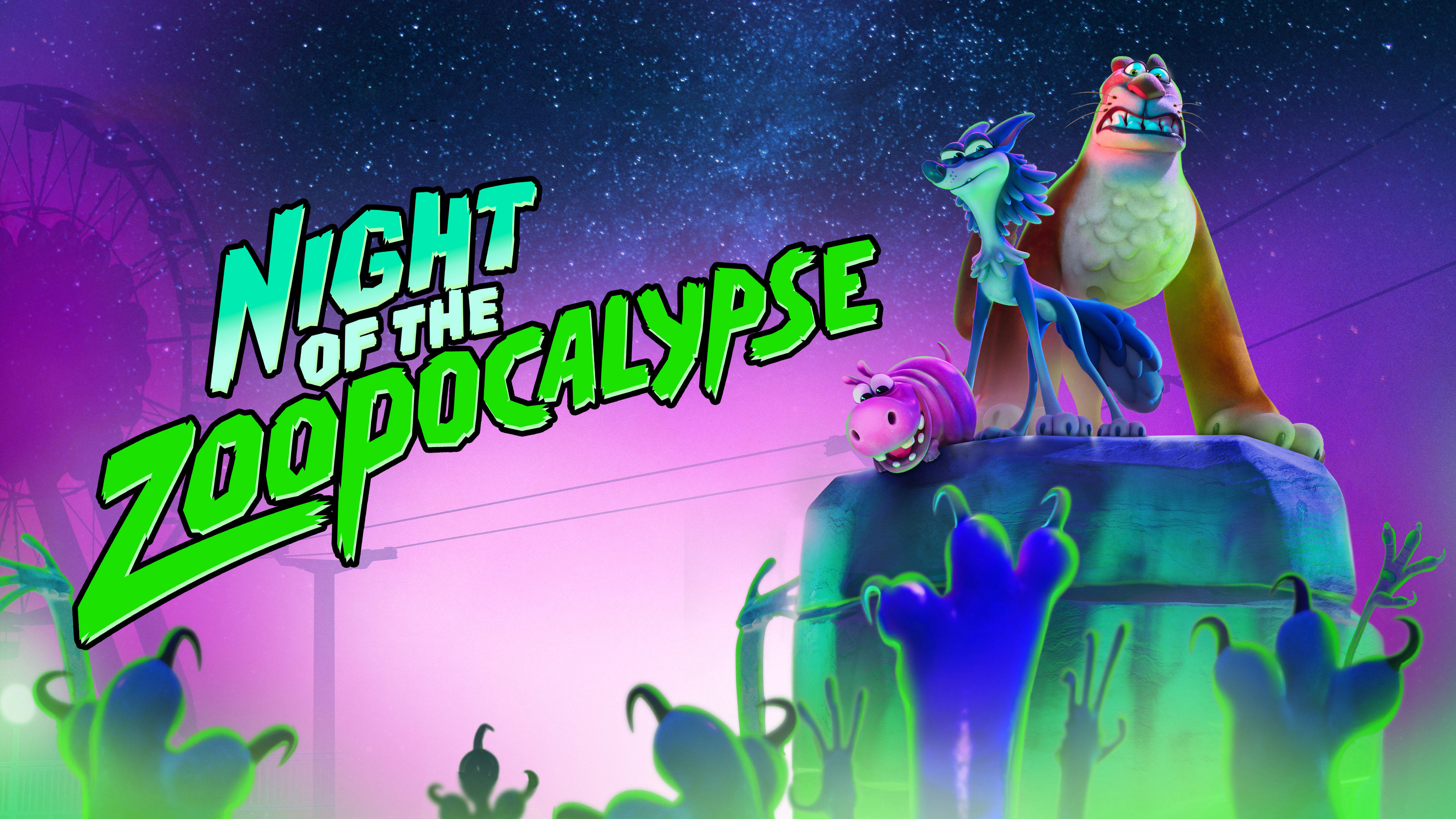

About fifteen minutes into Night of the Zoopocalypse, it becomes clear this movie knows exactly what it is — and, more importantly, what it isn’t. This is not a children’s animation pretending to be edgy. It’s also not a horror film embarrassed by its cartoon roots. Instead, it sits in that narrow, risky space where absurdity, menace, and surprisingly sharp observation coexist. Sometimes awkwardly. Sometimes brilliantly.
The real question isn’t whether Night of the Zoopocalypse is scary, funny, or weird enough. It’s whether that odd combination actually holds together long enough to be worth your time.
Quick facts
Night of the Zoopocalypse is an animated horror-comedy that blends creature-feature chaos with slapstick humor and satirical edge. Directed by Ricardo Curtis and Rodrigo Perez-Castro, the film features voice performances from David Harbour, Paul Sun-Hyung Lee, Scott Thompson, and Gabbi Kosmidis. Clocking in at a tight runtime just over ninety minutes, the film clearly aims for momentum over depth, leaning into genre fusion rather than broad family appeal.
Plot overview (no spoilers)
Set over the course of one catastrophic night, the story unfolds inside a zoo after a mysterious outbreak begins transforming animals into something far more aggressive — and far less cute. As the infection spreads, a small group of survivors must navigate enclosures turned into battlegrounds, facing predators that no longer follow the rules of nature.
Rather than focusing on a single heroic arc, the film operates as an ensemble survival story. Different personalities collide under pressure, alliances form out of necessity, and the line between instinct and intelligence blurs as the night spirals out of control.
The plot moves fast, rarely pausing to explain itself — a choice that defines both the film’s energy and its limitations.
Analysis & critique
Story & pacing
The pacing is one of Night of the Zoopocalypse’s biggest strengths. The film wastes no time establishing tone: chaos arrives early, and the narrative never really lets up. Scenes flow into each other with the urgency of a B-movie horror marathon, keeping the runtime lean and focused.
That said, speed comes at a cost. Character backstories are sketched rather than explored, and emotional beats often arrive and pass before they’ve fully landed. The film prioritizes escalation over reflection, which works for tension but limits resonance.
The script is self-aware without being smug. It understands horror tropes — quarantines, last stands, infected monstrosities — and plays with them rather than parodying them outright. When it stumbles, it’s usually because the story chooses convenience over logic, asking the audience to accept leaps that aren’t always earned.
Performances
David Harbour’s voice performance stands out, anchoring the film with a gruff, weary presence that contrasts nicely with the absurdity around him. He brings just enough sincerity to keep the character from becoming a punchline, even when the script flirts with caricature.
Paul Sun-Hyung Lee and Scott Thompson provide tonal balance, leaning into comedic timing without deflating tension entirely. Their performances understand that humor works best here when it relieves fear, not replaces it.
Gabbi Kosmidis adds emotional grounding, though her character is given less to do beyond reacting to escalating danger. It’s not a weak performance — just one constrained by the film’s relentless pace.
Across the board, the voice acting is solid, but rarely transformative. The characters serve the story’s momentum more than its emotional depth.
Visual style & animation
Visually, Night of the Zoopocalypse embraces stylization over realism. The animation favors exaggerated expressions, sharp silhouettes, and dynamic movement, making the action easy to follow even when things get crowded.
Creature design is where the film shines. The infected animals are unsettling without tipping into grotesque excess, balancing horror imagery with cartoon elasticity. The filmmakers clearly understand how far to push visual discomfort without alienating the audience entirely.
Lighting plays a major role. Harsh shadows, emergency reds, and sickly greens dominate the palette, giving the zoo an oppressive, claustrophobic feel despite its open spaces. It’s effective atmosphere-building, even if some environments start to blur together visually.
Music & sound
The score is functional rather than memorable, leaning heavily on percussive tension cues and sudden stings. It does its job — raising stakes, signaling danger — but rarely adds emotional complexity.
Sound design, however, is more effective. Animal noises are distorted just enough to feel wrong, reinforcing the idea that nature itself has been corrupted. Silence is used sparingly, but when it appears, it lands hard.
The film occasionally overuses audio cues to force tension, but never to the point of exhaustion.
Themes & meaning
Beneath the chaos, Night of the Zoopocalypse flirts with themes of containment, control, and human arrogance. The zoo becomes a metaphor so obvious it almost trips over itself — humans believing they can manage nature until nature pushes back.
The film doesn’t dig deeply into these ideas, and it doesn’t pretend to. They exist more as texture than thesis. What matters more is the instinctual behavior under pressure: who adapts, who panics, and who clings to rules that no longer apply.
It’s not a profound film, but it’s not empty either. It knows its limits and stays within them.
Strengths and weaknesses
The film’s biggest strength is clarity of intent. It doesn’t aim to be a prestige animated feature or a deep psychological horror. It aims to be a fast, nasty, darkly funny survival story — and largely succeeds.
Its weaknesses are tied to ambition. Character development is thin, emotional stakes are shallow, and some narrative shortcuts are too obvious to ignore. The humor occasionally undercuts tension rather than enhancing it.
Compared to other animated genre hybrids, Night of the Zoopocalypse is more committed to horror than most, but less emotionally layered than the best of them.
Who is this movie for?
This film is for viewers who enjoy genre mashups and aren’t looking for animation to play it safe. If you appreciate horror with a sense of humor and don’t mind shallow characterization in exchange for momentum, this will likely work for you.
If you’re expecting a family-friendly experience or a deeply emotional animated story, this isn’t it — and it doesn’t want to be.
Final verdict
Night of the Zoopocalypse is lean, chaotic, and unapologetically weird.
It doesn’t overstay its welcome, doesn’t soften its edges, and doesn’t pretend to be more meaningful than it is. While it lacks emotional depth and narrative refinement, it compensates with energy, atmosphere, and a clear understanding of its own appeal.
Sometimes a movie doesn’t need to be profound to be effective. Sometimes it just needs to know when to let the animals loose — and when to cut to black.