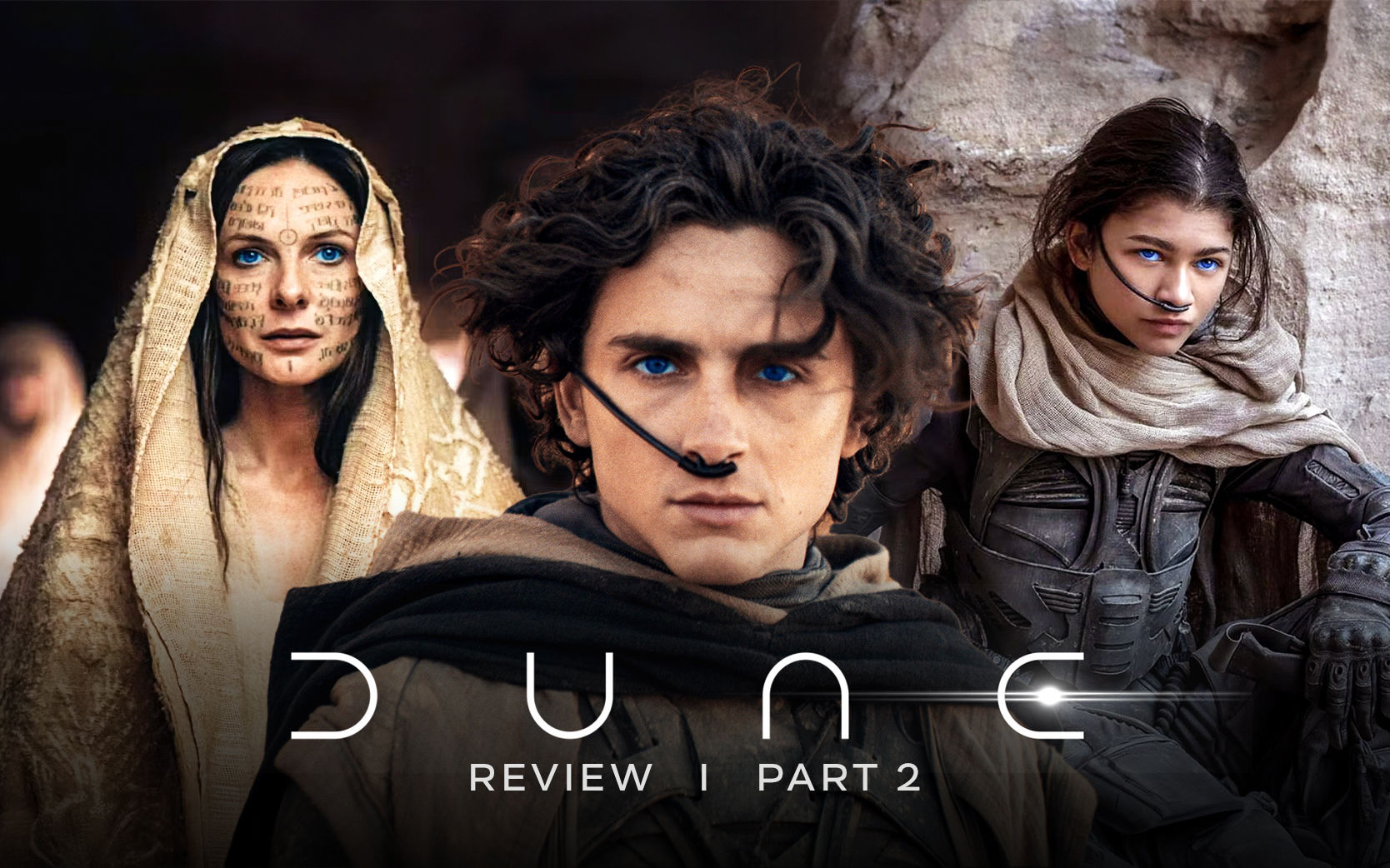
About halfway through Dune: Part Two, there’s a moment where the film stops feeling like a sequel and starts feeling like a warning. Not a metaphorical one. A very literal, very human warning about what happens when belief, power, and destiny collide — and nobody is brave enough to step off the path once it’s paved.
This is not the rousing hero’s journey many people expected. It’s colder. Sharper. And far less interested in giving you someone to cheer for without hesitation. If Dune: Part One asked for patience, Part Two demands reflection — and it doesn’t care if that makes you uncomfortable.
Quick facts
Dune: Part Two is a science fiction epic directed by Denis Villeneuve, continuing his adaptation of Frank Herbert’s novel. The film stars Timothée Chalamet, Zendaya, Rebecca Ferguson, Javier Bardem, Austin Butler, Josh Brolin, and Florence Pugh. With a runtime just under three hours, the film expands the scope of Arrakis while narrowing its emotional focus, shifting from world-building to consequence. This is less about introducing a universe and more about watching it break under the weight of belief.
Plot overview (no spoilers)
Following the fall of House Atreides, Paul and Jessica seek refuge among the Fremen, immersing themselves in a culture built on survival, prophecy, and deeply ingrained faith. What begins as adaptation slowly becomes transformation.
As external threats close in, Paul’s internal struggle takes center stage. He’s torn between resisting the role others project onto him and exploiting it to achieve a larger goal. The conflict is no longer just between houses or empires, but between agency and inevitability.
The film builds toward large-scale confrontation, but the real tension lies in quieter decisions — moments where power is accepted not because it’s wanted, but because it’s available.
Analysis & critique
Story & pacing
Villeneuve makes a bold structural choice here: Dune: Part Two is less plot-driven than it is momentum-driven. The story unfolds like a slow avalanche — inevitable once it starts, horrifying once you realize it can’t be stopped.
The pacing is deliberate but tighter than Part One. Gone are the extended introductions and exposition-heavy stretches. In their place is a steady escalation of ideological conflict. Scenes are allowed to breathe, but they always push toward consequence.
That said, the film occasionally mistakes restraint for distance. Certain emotional beats — particularly Paul’s internal conflict — are conveyed more through implication than exploration. For some viewers, this will feel intellectually rewarding. For others, it may feel emotionally withheld.
What the film never does is simplify. There’s no clean line between right and wrong, no comforting moral center. Villeneuve trusts the audience to connect the dots — and to sit with what those connections imply.
Performances
Timothée Chalamet delivers his most controlled performance as Paul Atreides. Gone is much of the uncertainty that defined him in the first film. What replaces it is something more unsettling: calm. His transformation is gradual, almost invisible, which makes it far more convincing.
Chalamet avoids grandstanding. Instead, he plays Paul as someone increasingly aware of his own myth — and increasingly willing to wield it. It’s a performance built on stillness, and it works.
Zendaya’s Chani finally steps into narrative prominence, grounding the film emotionally. She serves as both anchor and skeptic, challenging Paul’s ascent without turning into a moral mouthpiece. Zendaya brings warmth and steel in equal measure, making Chani feel like a person rather than a symbol.
Rebecca Ferguson continues to be quietly terrifying. Her Lady Jessica is serene, strategic, and unnervingly certain. What could have been played as fanaticism is instead portrayed as cold competence — arguably the film’s most frightening element.
Austin Butler’s Feyd-Rautha is deliberately grotesque, bordering on operatic. His performance is theatrical in a way that contrasts sharply with Villeneuve’s restraint. Whether that works depends on taste, but there’s no denying his presence injects volatility into every scene.
Visual style & cinematography
Visually, Dune: Part Two is austere and overwhelming. Greig Fraser’s cinematography continues the franchise’s commitment to scale without clutter. Wide shots emphasize insignificance; close-ups isolate characters within their own choices.
The color palette is stark — bleached deserts, brutal shadows, oppressive darkness. Arrakis feels less like a location and more like a psychological pressure chamber. The imagery doesn’t romanticize the setting. Survival looks exhausting. Faith looks dangerous.
Action scenes are sparse but monumental. Villeneuve avoids chaos, favoring clarity and weight. When violence erupts, it feels consequential rather than thrilling — a deliberate refusal to glamorize conflict.
Music & sound
Hans Zimmer’s score is more aggressive here, but also more focused. The music doesn’t swell to celebrate victories. It pulses, warns, and sometimes overwhelms. Percussion dominates, reinforcing the sense of inevitability.
Sound design plays a crucial role. The absence of sound is often more impactful than the presence of music. Silence lingers after major moments, denying emotional release and forcing the audience to process what they’ve just witnessed.
This is not a comforting soundscape. It’s confrontational — and intentionally so.
Themes & meaning
At its core, Dune: Part Two is about the seduction of destiny.
The film interrogates the idea of the chosen one without dismantling it entirely. Instead, it shows how belief systems — religious, political, cultural — can transform individuals into instruments, regardless of intent.
Paul’s journey is not framed as triumph. It’s framed as surrender — not to weakness, but to momentum. The film asks whether knowing the future absolves you from responsibility, or damns you even further.
Unlike many blockbusters, Dune: Part Two doesn’t offer emotional closure. It offers escalation. The story ends not with resolution, but with the unsettling sense that something irreversible has begun.
Strengths and weaknesses
The film’s greatest strength is its confidence. It refuses to simplify complex ideas for accessibility. It trusts its audience to engage with ambiguity, discomfort, and moral compromise.
Its weaknesses stem from the same choice. Emotional detachment may alienate viewers looking for catharsis or character-driven warmth. Some relationships feel underexplored, sacrificed for thematic focus.
Compared to Part One, this film is more narratively efficient but less meditative. Compared to other modern sci-fi epics, it’s far less interested in spectacle for spectacle’s sake.
Who is this movie for?
Dune: Part Two is for viewers who appreciate science fiction as philosophy, not just world-building. If you’re drawn to stories about power, belief, and unintended consequences, this film delivers in full.
If you want a clear hero, emotional payoff, or triumphant ending, this may leave you cold. That’s not a flaw — it’s a statement.
Final verdict
Dune: Part Two doesn’t ask you to celebrate destiny. It asks you to question it.
It’s a controlled, uncompromising continuation that deepens the story by stripping away comfort and certainty. This is blockbuster filmmaking that respects intelligence and embraces discomfort — a rarity in a genre increasingly afraid of both.
Power, once claimed, doesn’t ask whether you’re ready. And Dune: Part Two makes sure you understand the cost of saying yes.