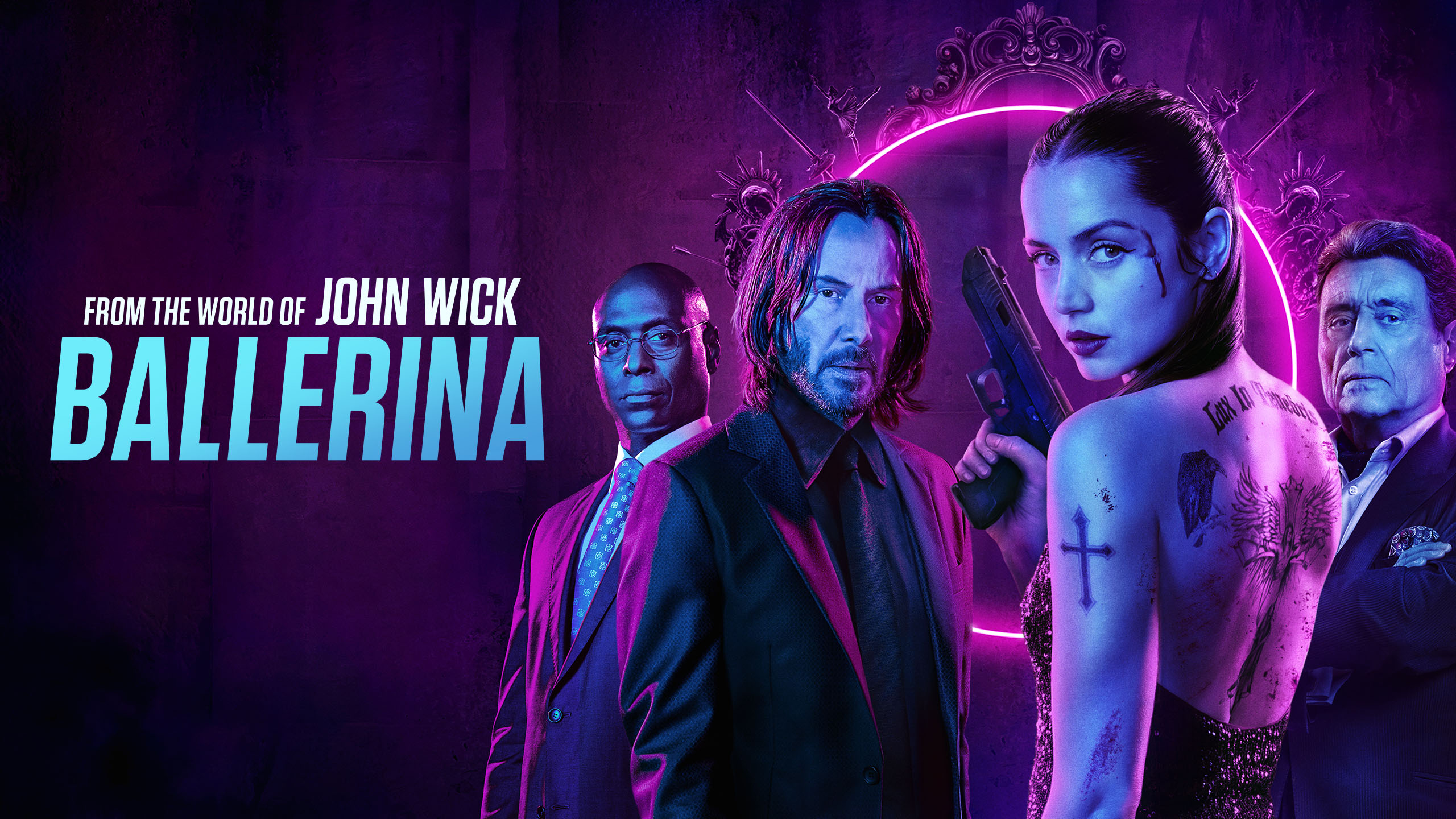

Review: John Wick: Ballerina
Opening
There’s a point in John Wick: Ballerina where you stop wondering how stylish the next kill will be—and start wondering whether the film actually has a reason to exist beyond proving it can keep up with John Wick himself. The bullets fly, bodies drop with balletic precision, neon lights reflect off polished floors… and yet, something feels slightly off. Not broken. Just unsteady.
Spin-offs live and die by one brutal question: are they expanding the world, or just renting it? Ballerina desperately wants to do the former. Whether it succeeds is more complicated.
Quick facts
John Wick: Ballerina is an action thriller set within the established John Wick universe, directed by Len Wiseman and led by Ana de Armas. The film leans heavily into gun-fu, close-quarters combat, and stylized violence, while featuring familiar faces from the franchise, including connections to the Continental and the shadowy assassin networks fans already know. The runtime sits just over two hours—long enough to build a character arc, but short enough that there’s no excuse for wasted momentum.
Plot overview (no spoilers)
The story centers on Rooney, a trained assassin raised within the same brutal traditions that shaped John Wick. Unlike Wick, whose journey was fueled by loss and rage, Rooney’s path is driven by something colder: purpose molded by indoctrination, sharpened by revenge.
As she moves deeper into the criminal underworld, the film explores what it means to inherit a system designed to erase individuality. Contracts are fulfilled, rules are obeyed, and violence is treated as ritual. The conflict isn’t just external—Rooney is constantly negotiating how much of herself she’s willing to lose in order to survive and succeed.
The plot remains relatively straightforward, prioritizing momentum and physical escalation over labyrinthine mythology. That simplicity is both a strength and a limitation.
Analysis & critique
Story & pacing
Ballerina understands one crucial thing: this universe works best when it doesn’t overexplain itself. The story is lean, direct, and mostly uninterested in philosophical monologues about fate or honor. Instead, it lets action define character.
Pacing is sharp in the first half. Scenes move with confidence, and the film avoids the trap of endless setup. Training, motivation, and conflict are established efficiently, allowing the narrative to push forward without stalling.
The issue arises in the second half, where escalation starts to blur together. Action sequences are choreographed with skill, but they arrive so consistently that individual moments lose their punch. The story doesn’t drag—but it does plateau. When everything is intense, intensity stops being special.
The script also plays it safe with its emotional beats. There are moments begging for moral friction or genuine consequence, but the film often chooses familiarity over risk.
Performances
Ana de Armas is the film’s undeniable anchor. She brings physical credibility to the role—every movement feels trained, intentional, and earned. More importantly, she avoids turning Rooney into a cold action archetype. There’s restraint in her performance, a quiet tension that suggests internal conflict even when the script doesn’t fully explore it.
She doesn’t try to be John Wick, and that’s the right choice. Where Wick is mythic and almost abstract, Rooney feels human—sometimes too human for a world that punishes hesitation.
Supporting performances are functional rather than memorable. Familiar faces from the franchise do their jobs well, but rarely surprise. They exist to reinforce continuity, not to challenge the narrative. No one phones it in—but no one steals the film either.
Visual style & cinematography
Visually, Ballerina stays loyal to the franchise’s aesthetic: stark lighting, rich shadows, and carefully framed violence. The color palette leans into cool blues and harsh whites, creating a clinical, almost sterile atmosphere that matches the film’s view of assassination as profession rather than passion.
Action is cleanly shot, favoring long takes and clear spatial awareness. You always understand where bodies are, where threats are coming from, and how each fight evolves. That clarity is refreshing in a genre often drowned in shaky cams and frantic cuts.
That said, the film rarely surprises visually. It looks good—sometimes great—but it rarely feels new. For a spin-off centered on a different perspective, the visual language plays it too safe.
Music & sound
The sound design is aggressive and precise. Gunshots hit with weight, impacts feel painful, and silence is used effectively before bursts of violence. The film understands that anticipation is as important as execution.
The score leans heavily into pulsing rhythms and electronic textures, reinforcing momentum rather than emotion. It works for action sequences but does little to deepen character moments. Music supports the motion, not the meaning.
There are moments where sound does more storytelling than dialogue—and those are some of the film’s strongest scenes.
Themes & meaning
At a thematic level, Ballerina flirts with ideas of autonomy, indoctrination, and inherited violence. It asks whether someone trained to kill ever truly chooses their path—or simply walks the one laid out for them.
The film deserves credit for posing these questions, but it doesn’t fully wrestle with them. Themes are introduced, acknowledged, and then quietly set aside to make room for the next set piece. The result is a movie that feels thoughtful without being challenging.
It wants to be about identity, but settles for professionalism. That’s not a failure—but it is a missed opportunity.
Strengths and weaknesses
The film’s strengths are clear: confident action choreography, a strong central performance, and a polished understanding of the John Wick universe. It respects the rules, the tone, and the audience’s expectations.
Its weaknesses stem from caution. The story doesn’t push far enough beyond familiar territory. Emotional stakes are hinted at rather than explored, and the film relies heavily on inherited goodwill from the franchise instead of forging a truly distinct identity.
Compared to the mainline John Wick films, Ballerina feels smaller—not in scale, but in ambition. It expands the universe horizontally, not vertically.
Who is this movie for?
If you’re a fan of the John Wick franchise and want more time in that world—more assassins, more rules, more beautifully choreographed violence—Ballerina delivers.
If you’re hoping for a spin-off that radically redefines the tone or challenges the mythology, this may feel too familiar. And if relentless action without deep character exploration wears you down, the film may blur together faster than it should.
Final verdict
The honest review of John Wick: Ballerina is this: it’s a well-made, well-acted spin-off that understands the mechanics of its universe but hesitates to truly expand its soul. Ana de Armas proves she can carry an action film with authority, and the violence remains as elegant as ever—but elegance alone isn’t evolution.
Is John Wick: Ballerina worth watching?
Yes—especially if you’re invested in the franchise and curious to see a different lens on its world. Just don’t expect it to dance too far from the choreography you already know.
Score: 6.8/10
Sometimes stepping into a legend’s shadow gives you protection. Other times, it reminds you how hard it is to escape it.