
Review: KPop Demon Hunters
There’s a moment early in KPop Demon Hunters when you realize the movie is walking a tightrope. On one side: a hyper-stylized K-pop fantasy that could easily collapse into brand-friendly noise. On the other: a supernatural action story that wants to be taken seriously but knows its audience came for color, rhythm, and attitude. The question isn’t whether this film is weird — it absolutely is. The question is whether it knows what kind of weird it wants to be.
Because this kind of concept either commits hard or falls apart fast.
Quick facts
KPop Demon Hunters is an animated action-fantasy musical produced for a global audience, blending Korean pop idol culture with demon-slaying mythology. Directed by Maggie Kang and Chris Appelhans, the film follows a fictional K-pop girl group whose onstage personas hide a far more violent offstage duty. The main voice cast features rising young performers rather than celebrity stunt casting, and the runtime stays comfortably under two hours, keeping the energy high and the pacing tight.
Plot overview (no spoilers)
The premise is refreshingly simple: by day, a chart-topping K-pop group. By night, elite demon hunters protecting the world from supernatural threats that feed on human emotion. Music isn’t just their brand — it’s their weapon, their shield, and their cover.
The conflict escalates when a new demonic force begins targeting the very thing that gives the group its power: their fans. As fame, identity, and secrecy collide, the characters are forced to confront what it actually costs to live a double life in a world that demands perfection.
Analysis & critique
Story & pacing
The story knows exactly what it is and, more importantly, what it isn’t. KPop Demon Hunters doesn’t waste time pretending to be grounded realism. It embraces heightened logic, exaggerated stakes, and emotional shorthand — and that’s the right call. The pacing is brisk without feeling rushed, moving cleanly from performance spectacle to action set piece to character moment.
Where the script stumbles slightly is in its midsection. Some emotional beats feel introduced and resolved too quickly, as if the film is afraid to linger and risk losing momentum. The result is a narrative that’s always engaging, but occasionally shallow. It wants to say something meaningful about identity and performance, but it rarely sits long enough to let those ideas breathe.
Still, it never drags — and in animated features aimed at broad audiences, that’s not nothing.
Performances
The voice performances are one of the film’s quiet strengths. Instead of leaning on star power, the cast focuses on tone and chemistry. The main group feels like an actual unit — distinct personalities, shared rhythm, believable tension. That cohesion matters, because the emotional core of the film depends on their bond feeling earned rather than manufactured.
No one performance dominates the film, and that’s intentional. This isn’t about a single hero — it’s about collective identity. Some supporting characters verge on archetype, but the leads carry enough nuance to keep the story grounded, even when the visuals go full neon chaos.
Visual style & cinematography
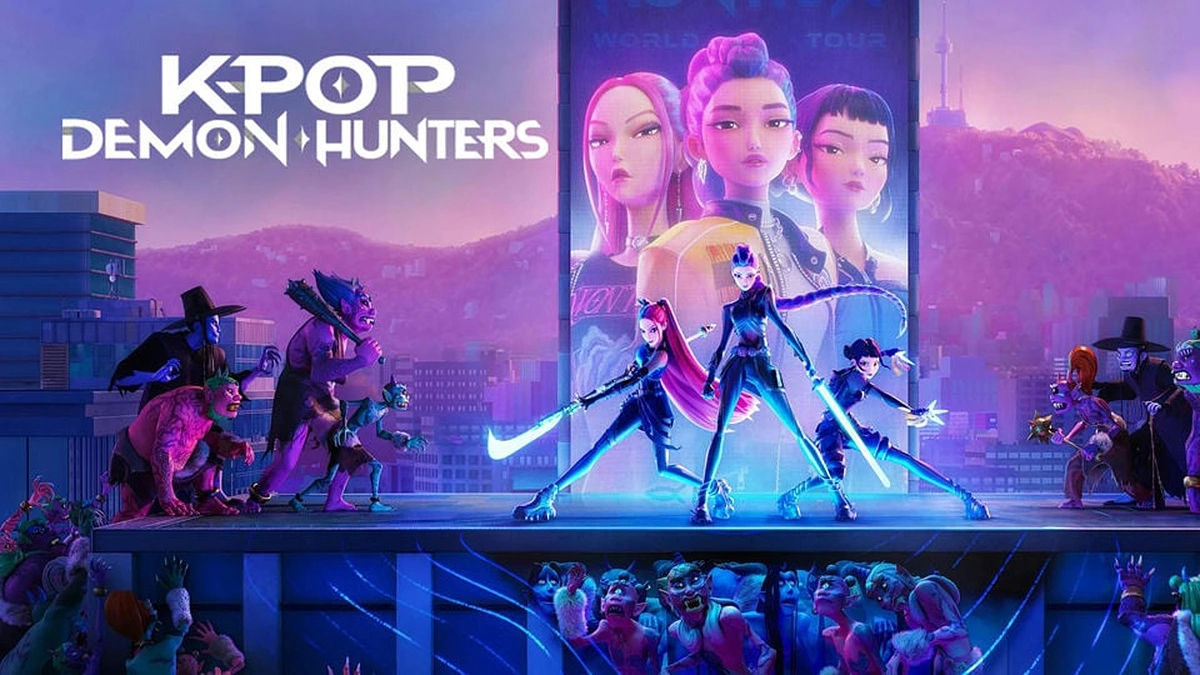
Visually, KPop Demon Hunters is unapologetically loud — but it’s not sloppy. The color palette leans heavily into saturated pinks, purples, and electric blues, echoing stage lighting and music video aesthetics. Character designs balance idol glamour with combat functionality, which sounds trivial but is harder than it looks.
The action choreography is sharp and readable. Camera movement flows with the music rather than fighting it, and the film understands when to pull back and let a sequence breathe instead of cutting every half-second. When the visuals serve both spectacle and storytelling, the film hits its stride.
That said, some background environments feel more decorative than immersive. The world outside the stage and battlefield is less defined, which subtly limits the film’s sense of scale.
Music & sound
This is where the film either wins you over or loses you completely.
The music is central — not just as soundtrack, but as narrative engine. Songs aren’t filler; they’re plot devices. When it works, it works extremely well, merging emotion, action, and character expression into a single beat-driven sequence. When it doesn’t, it feels like a pause button labeled “music video.”
The score knows when to step aside, letting silence or ambient sound create tension before dropping the next rhythmic hit. The sound design during combat is crisp and punchy, never overwhelming, and often synced cleverly with choreography.
Themes & meaning
At its heart, KPop Demon Hunters is about performance — not just on stage, but in life. The film explores the idea of identity as something curated, protected, and sometimes weaponized. Fame isn’t portrayed as pure fantasy, nor as outright corruption. It’s a tool, and like any tool, it can cut both ways.
The film also touches on parasocial relationships and emotional consumption — demons feeding on human devotion isn’t exactly subtle — but it’s effective. Where the movie plays it safe is in resolution. The themes are introduced clearly, explored competently, and then wrapped up neatly. It’s satisfying, but not challenging.
Strengths and weaknesses
The film’s biggest strength is confidence. It commits fully to its hybrid identity — part concert, part action movie, part supernatural fantasy — without apologizing for the blend. Compared to other animated films that try to soften cultural specificity for global appeal, KPop Demon Hunters leans into its influences instead of sanding them down.
Its weakness lies in emotional depth. While the characters are likable and well-defined, their arcs resolve a bit too cleanly. The film gestures toward complexity, but often opts for clarity over risk. It’s entertaining, but rarely surprising.
Who is this movie for?
This film is perfect for viewers who enjoy stylized animation, music-driven storytelling, and genre mashups that don’t take themselves too seriously. If you appreciate animation that feels designed rather than generic, there’s a lot to like here.
If you’re allergic to musical elements or prefer grounded, lore-heavy fantasy, this may feel thin or overly flashy. The question “Is KPop Demon Hunters worth watching?” depends on whether you’re open to its rhythm-first approach.
Final verdict
KPop Demon Hunters doesn’t pretend to reinvent animation or redefine genre storytelling. What it does is deliver a focused, energetic, and visually confident experience that knows its audience and respects their intelligence just enough.
As a review of KPop Demon Hunters, the verdict is clear: it’s not deep enough to linger in your thoughts for weeks, but it’s sharp enough to earn your time. Stylish, self-aware, and occasionally smarter than it looks.
Score: 7.5/10
Not a revolution — but a reminder that commitment and clarity still matter more than chasing universality.