
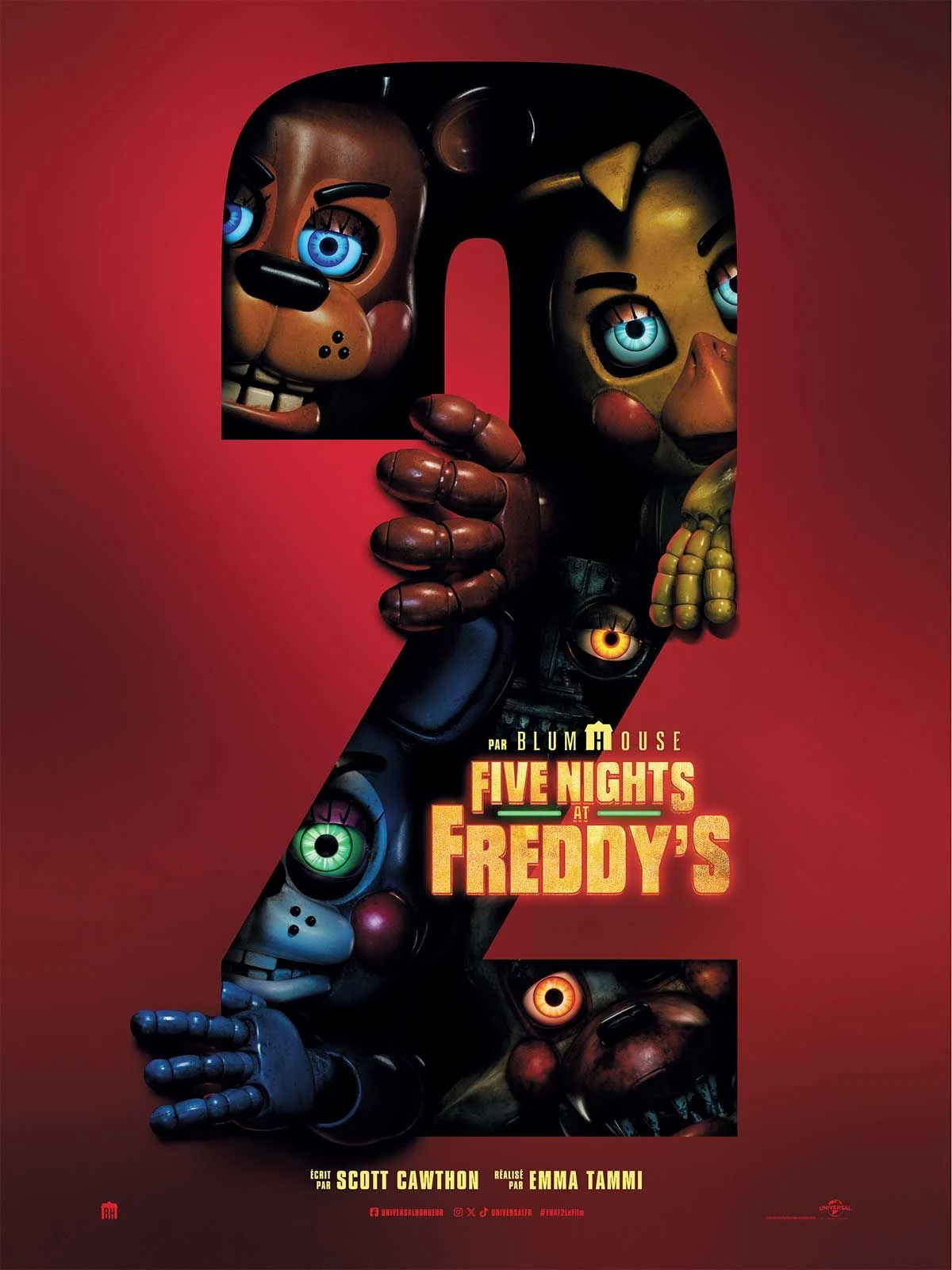
Review: Five Nights at Freddy’s 2
Opening
There’s a specific kind of tension Five Nights at Freddy’s 2 relies on—one that doesn’t come from jump scares alone, but from waiting. Waiting for a door to fail, for a camera feed to glitch, for something you know is coming but can’t quite see yet. About thirty minutes in, it becomes clear the film understands this feeling better than its predecessor ever did. The real question is whether it knows what to do with that understanding—or if it’s still hiding behind fan service and noise.
So let’s be blunt: is Five Nights at Freddy’s 2 an actual horror sequel, or just a louder extension of the brand?
Quick facts
Five Nights at Freddy’s 2 is a supernatural horror thriller directed by Emma Tammi, returning after the first film’s mixed reception. The movie brings back key cast members while expanding its ensemble, blending familiar faces with new characters tied to Freddy Fazbear’s increasingly cursed legacy. With a runtime just under two hours, it’s leaner than many modern horror blockbusters and clearly aimed at tightening tension rather than inflating spectacle.
Plot overview (no spoilers)
Set after the events of the first film, Five Nights at Freddy’s 2 shifts focus from survival to consequence. The haunted pizzeria may be closed—or repurposed—but the damage it caused didn’t end when the doors shut. Characters return carrying trauma, guilt, and unfinished business, while a new setting introduces a fresh variation on the same nightmare.
The central conflict revolves around escalation. What was once contained and vaguely understood has grown more aggressive, more unpredictable. The animatronics are no longer passive threats waiting to be triggered; they’re active participants in a cycle that keeps repeating because no one has fully confronted its source.
The film avoids dumping lore all at once, choosing instead to let the mystery bleed out gradually. Whether that restraint works depends heavily on your tolerance for ambiguity.
Analysis & critique
Story & pacing
This is where Five Nights at Freddy’s 2 makes its strongest case for existence. Unlike the first film—which often felt like it was explaining itself to death—this sequel is more confident in letting scenes breathe. The story it’s trying to tell is simpler but sharper: trauma doesn’t reset, and ignoring it only makes things worse.
Pacing is noticeably improved. The film wastes less time on exposition and gets to the point faster. That doesn’t mean it’s perfectly balanced—there are still stretches where momentum dips—but the structure feels intentional rather than accidental. Tension builds in waves instead of spikes, which suits the franchise’s core identity.
That said, the script still stumbles when it tries to connect every dot. Some narrative threads feel forced into alignment, as if the movie is afraid of leaving anything unexplained. Horror thrives on uncertainty, and FNAF 2 occasionally undermines itself by talking too much when silence would have been more effective.
Performances
Josh Hutcherson returns with a more grounded, controlled performance than in the first film. His character feels less reactive and more burdened—someone who understands the rules of this nightmare but is tired of playing by them. It’s not flashy work, but it’s credible, which matters more in horror than grand gestures.
The supporting cast is uneven but improved overall. A standout newcomer brings genuine unease to the screen, not through exaggerated fear but through quiet, believable dread. On the flip side, a few side characters feel underdeveloped, existing mainly to move the plot forward or become casualties when tension needs a boost.
No one is outright bad. Some just feel underused.
Visual style & cinematography
Visually, Five Nights at Freddy’s 2 is darker—literally and tonally. The color palette leans into deep shadows, sickly yellows, and cold blues, reinforcing the sense of decay and unease. Unlike the first film, which sometimes looked too clean for its subject matter, this sequel embraces grime and claustrophobia.
The camera work is more deliberate. Slow pans, lingering frames, and restricted viewpoints mirror the gameplay roots of the franchise without directly copying them. When the film locks you into a space and refuses to let you look away, it works extremely well.
Not every scare lands, but when the visuals align with the tension, the atmosphere is genuinely effective.
Music & sound
Sound design does most of the heavy lifting here. Mechanical whirs, distant footsteps, and sudden drops into silence create a constant sense of anticipation. The film understands that fear often comes from what you don’t hear as much as what you do.
The score is minimal and restrained, showing more confidence than the first film’s tendency to over-emphasize emotional beats. When music swells, it usually earns it. When it doesn’t, the film leans on ambient noise instead—a smart choice for this kind of horror.
There are still a few moments where jump scares are telegraphed by audio cues, but they’re less frequent and less obnoxious than before.
Themes & meaning
At its core, Five Nights at Freddy’s 2 is about cycles—of violence, neglect, and denial. It suggests that monsters aren’t just created by singular acts of evil, but by systems that allow harm to repeat unchecked. The animatronics aren’t just haunted objects; they’re symptoms.
The film doesn’t pretend to be deep social commentary, and that’s to its credit. It keeps its themes grounded and personal, focusing on guilt, responsibility, and the cost of refusing to confront the past. When it works, it gives the horror emotional weight instead of relying solely on shock value.
Does it fully earn its message? Mostly. There are moments where symbolism edges toward heavy-handedness, but it never collapses under its own seriousness.
Strengths and weaknesses
The biggest improvement Five Nights at Freddy’s 2 offers is restraint. It trusts atmosphere over exposition, mood over mythology dumps. The pacing is tighter, the visuals more purposeful, and the horror more consistent. It finally feels like a movie that understands why the franchise resonates beyond jump scares.
Its weaknesses are familiar ones. The film still struggles to balance fan service with standalone storytelling. Some character arcs feel incomplete, and a few narrative explanations feel unnecessary. Compared to stronger horror sequels in the genre, it plays things relatively safe.
But safe doesn’t mean lazy—and that’s an important distinction.
Who is this movie for?
If you’re a fan of the Five Nights at Freddy’s games and felt let down by the first film, this sequel is a noticeable step up. It respects the source material without drowning in it and delivers a more coherent horror experience.
If you’re looking for boundary-pushing, deeply unsettling horror, this won’t replace genre heavyweights. And if animatronic-based scares do nothing for you, no sequel is going to change that.
Final verdict
The honest review of Five Nights at Freddy’s 2 is this: it’s not a reinvention, but it is a correction. A smarter, tighter, more confident sequel that understands its own strengths and stops apologizing for what it is.
Is Five Nights at Freddy’s 2 worth watching?
Yes—especially if you wanted the first film to be scarier, quieter, and more focused. Just don’t expect it to transcend the franchise that built it.
Score: 7.5/10
Sometimes survival horror works best when it stops trying to explain the nightmare—and just lets you sit with it in the dark.